Tuesday, August 29, 2017

Park Tool CN-10: Well-Designed and Useful Cycling Tool

Park Tool CN-10 Professional Cable and Housing Cutter


Park Tool CN-10 Cable and Housing Cutter
If you, as do I, have several bicycles around the house and the garage and have come to the realization that you'd much rather perform your own normal maintenance out in the garage than go without your bike for a week, one of the critical tools you're going to need in your bike maintenance arsenal is a cable and housing cutter. Don’t be like me: the first few times I replaced a shift cable, I dug my ordinary wire cutters out of my toolbox. The result was a nightmare threading the cables through the housings and fitting a ferrule on the cut end. I've even tried using a dab of solder to “silver” the end of the cable.

Tuesday, July 25, 2017

What Cyclists Wish Drivers Knew 4: We Can’t Always Ride on that Bike Path!

Talk about your bridge to nowhere...
If often seems to me that there are only two kinds of people in this world, or at least on the internet: there are the people who ride bicycles on the streets and there are the people who detest them. Sorry, that’s kind of a generalization… but when it comes to being vocal about cyclists and cycling on the streets, the dichotomy certainly seems to fit. All you need do is look at the comment section on any story about bicycles or cyclists, and you’ll see plenty of venting from the second group. Take, for instance, a recent post in the “Let It Out” section of the Indianapolis Star, in which the anonymous writer asked, “Why is this guy riding his bicycle in the street when our taxes paid for that nice new bike path?”

You see the word “taxes” come up a lot in discussions of bicycles on streets, since so many non-cyclists are of the (mistaken) impression that gasoline taxes and vehicle registrations pay to maintain local streets: they don’t – local property taxes pay the bulk of that cost. But that’s not my point today – my point is the question, “Why aren’t you using the bike path my money built for you, Lycra-clad loser?” The answer’s pretty simple, especially in towns that – like Indianapolis – are at best only moderately bicycle-friendly: The bike paths don’t go where I need to go; the streets do.

      There’s more, of course. When people drive cars – and most adult cyclists also drive – they generally take the most efficient route. That means avoiding heavy, slow-moving traffic and streets that are in such poor repair that they slow them down. They use I-74 instead of Crawfordsville Road to get from Brownsburg to Indy, for instance. Well, on a bicycle, it’s the same: it’s inefficient to try to ride the Monon Trail when it’s filled with strollers, and it’s nearly impossible to ride the Fall Creek Trail when (and after) the creek has flooded it. I’ve seen bike trails blocked by standing water, fallen trees, official trucks (lots of times), landscaping crews’ trucks, and bridge construction; to name a few reasons I found myself riding in the street.

That’s assuming, of course, that there’s a trail – and that it’s continuous. Out in Hamilton County, many a trail has been built up to the limits of the subdivision, where it then simply ends. We’ve even seen bridges to nowhere on some of our rides (see photo above). Alleged bike paths that just stop in the middle of a block dump riders out onto the streets, sometimes at seriously bad locations. Oh, and for what it’s worth? Many of those bike paths are part of the subdivision’s green space, and weren’t built with taxpayer funds…

So gimme a break, please, drivers! The reason I’m in the street instead of on the bike path is  the same reason you’re on that street: it goes where I’m trying to go!

copyright © 2017 scmrak

Friday, July 14, 2017

Axiom Lazer 500: Nice Light, Lousy Mount

Axiom Lazer 500 LED Headlight


UPDATED: See red text at bottom of page

A recent painful encounter with a distracted driver – well, actually, with the side of her van – reminded me that no cyclist is ever too visible. While neon jerseys and rear-facing blinking lights may serve to alert a driver overtaking you, some of the ones in front of you also need a visual nudge or two. One of those strobing headlights seemed to be just the ticket, so a pair of them appeared just in time for Mothers Day. They’re both the Axiom Lazer 500 LED Headlight.

Axiom Lazer 500 LED Headlight
According to the manufacturer’s specs, the Lazer 500 puts out 500 lumens of bright blue-white light. It features four modes: three different intensities of steady and a strobing flash. The lithium polymer battery is rechargeable from a USB port (charging cable included). Axiom says the battery lasts for up to 36 hours of flashing, or 2.5 hours at maximum steady intensity. The stated recharge time is five hours.

Lazer headlights come with a clamp-style handlebar mount that installs without tools. The light unit is removable for charging, and the mount allows me to swing the light from side to side to “see around corners” or, more commonly, point it at drivers approaching from the side.

There’s a one-button ON-OFF switch that you hold down to turn on or off or to activate the strobe function. Pressing the button while in steady mode changes the intensity. LEDs in the switch tell you that the light is working (green) and that the battery is below 15% charge (red). The light’s visible from several hundred feet away in strobe mode, though not really noticeable in bright sunlight beyond a couple hundred feet (3 seconds at 60 MPH).

     I like that the Lazer 500 locks in its mount, because otherwise the bumpy local streets would probably bounce it off within a few hundred yards; I also like that swivel feature. I don't ride in the dark, so I can't speak to its use as a headlight: I bought this for safety.

What I don’t care for is Axiom's handlebar mount: it’s hard plastic with an optional corrugated rubber insert, and a screw with a knurled knob to tighten the mount in place. The rubber insert can’t be used on our 31-mm bars with their slightly oval cross-section, which leaves hard plastic in direct contact with the handlebar (it can’t be mounted on the stem, for whatever that’s worth). As a result, the relatively low friction allows the mount to turn just a little as I ride, which eventually points the light downward. I’m careful to only rotate the mount itself instead of trying to use the light, but geez, guys, don’t you realize that many bikes don't have skinny handlebars any more?

As for battery life: the battery in one of our lights lasted twice as long as the other on its first charge, but since then the two seem to be keeping similar recharging schedules of perhaps 30-35 hours.

Axiom also sells a 700-lumen model (cunningly called the Lazer 700) and sets with both headlight and blinking tail light. I like the visibility and the rechargeable battery of my Lazer, but I’m less impressed by its mount. If the clamp were sized for real bikes, I’d like it a lot better. As it is, I’m just “meh” about it, mostly because I am suspicious that the mount is not going to last as long as the light.      

And I was right: three times, the mount has broken on bumpy city streets, broken in such a way that it cannot be repaired. I'd say that mount ins worse than "Meh," it's utter crap. Buy any brand but this one...
copyright © 2017-2019 scmrak

Monday, July 3, 2017

She Said, He Said: Road Rage or Driver Intimidation?

unsafe passing distance cyclist
Transcripts of a couple of Indianapolis newscasts have come across my email of late, newscasts that tell wildly different stories about the same incident. It was initially labeled a case of "unprovoked road rage" on the part of an anonymous local cyclist. The cyclist has now been identified, and he has a... different take on the incident. It's now turned into a case of he said, she said... and you can be pretty sure that neither one is telling the truth, the whole truth, and nothing but the truth...

Friday, June 16, 2017

The Indy Cyclist’s Guide: Fall Creek Trail

If the Monon Rails to Trails project is the centerpiece of the Indianapolis cycling universe, the Fall Creek Trail is its redheaded stepsister. This trail – for the most part – sees far less traffic than the Monon; probably because the latter connects two of the Circle City’s most popular hipster havens, Broad Ripple and Mass Ave. That may also be why the Fall Creek trail is often – to be polite – less well-maintained.

Fall Creek Greenway Indianapolis
The trail has an “official” length of just over 13 miles (20.9 km), beginning at… well, no one knows quite where it begins, since it’s supposed to connect to the White River Greenway near 10th Street (but doesn’t). An official map shows the trail beginning at the intersection with the Monon half a mile or so south of 38th Street, though the physical trail continues south along Fall Creek until interrupted by construction near Central Avenue. On the northeast, the map shows it ending at mile 11 (actually mile 12) near Skiles Test Park, but in reality it extends to the Boy Scout Road bridge over the creek and a back entrance to Fort Harrison State Park. I’ll be talking about the section between the Monon and Fort Harrison.

Monon Trail to Binford Boulevard


The Monon Trail crosses Fall Creek and the trail on an elevated bridge. An access ramp connecting the trails can be found on the east side of the Monon near the north end of the bridge. Warning: watch for bicycles coming up the ramp! Down on the Fall Creek trail, there’s a small rest area equipped with benches. A cement post a few yards upstream marks this as Mile 6.0 on the Fall Creek Trail. From there, a paved asphalt trail extends in both directions…

…for a while: a little under half a mile up the trail, riders come to 38th Street – near northern Indy’s busiest east-west artery. The trail continues – if you can call it that – east on the sidewalk of the 38th Street bridge over Fall Creek. The broken, poorly-patched concrete sidewalk is studded with utility poles and barely wide enough for two pedestrians to pass. In short, it’s extremely dangerous – parents thinking this would be a good place for a child with training wheels will be shocked to find this on a “hike and bike trail.” Riders turn north to cross 38th at an intersection without a signal before the paved trail picks up on the other side.

The trail briefly follows Millersville Road and the (mostly abandoned) Nickel Plate rails before diving under Keystone Avenue and winding through a small, surprisingly woody area. After crossing the creek on a pedestrian bridge parallel to Binford Boulevard, the trail reaches a parking area just east of the intersection of Binford and Fall Creek Parkway North, at approximately mile 7.5 of the trail. A side trail at 39th Street gives trail users access to the east entrance of the Fairgrounds via a historic limestone bridge and a signal-controlled crossing of Binford.

Binford Boulevard to Skiles Test Park


The 2.25 miles between the parking area and the six-way intersection of Fall Creek Parkway, Emerson, and 56th Street runs between parkway and creek. It passes under 46th, Emerson, and 56th before turning east to follow the Parkway from its intersection with Kessler Boulevard at about mile 10. Watch for a steep, slick climb northbound on a wet wooden bridge under 56th street, and beware of heavy growth of poison ivy in the adjacent underbrush. The pavement in this section is often narrow and rough, with many ridges caused by tree roots. It’s also subject to flooding and mud when the weather has been rainy. Road cyclists generally ride on the Parkway, which alternates between smooth, fresh pavement and broken, potholed asphalt.

From Kessler and Fall Creek the trail again runs between the parkway and the creek. This section is wide and smoothly paved, unlike the portion of the trail west of Emerson, with a better surface than the street it parallels. It's curvy and and has lots of little rolling hills. Pullouts along the Parkway about every half mile act as parking areas for the trail, with an official trailhead near mile 12.25 where there's a side trail into Skiles Test Park. Four tenths of a mile up that trail lies another parking area, and the trail continues up a steep (for Indy) hill 0.75 miles to meet 65th street east of Johnson Road.
    

Skiles Test Park to Boy Scout Road


The Fall Creek Trail continues, passing underneath I-465 – watch for mud beneath the southbound lanes, which never seems to be cleaned – then alongside Fall Creek Road for 0.8 miles to the current end of the trail at Boy Scout Road. The trail crosses the intersection to the sidewalk on the north side of the bridge, at the end of which a trail continues into Fort Harrison State Park. The intersection's crosswalk is clearly marked, but still unacceptably dangerous because of heavy, high-speed traffic and the need to make a sharp right-hand turn from the pavement to the narrow sidewalk. Many cyclists prefer to ride in the traffic lanes instead of attempting the crossing.

The Bottom Line


There are no amenities along the trail beyond an occasional bench at a trailhead. There are no water fountains and no public restrooms anywhere in its length. Water and restrooms are available within Fort Harrison State Park, and there are businesses at the Fall Creek / Emerson / 56th Street intersection – including a Starbucks, a CVS, and Lincoln Square Pancake House.

     Unlike the Monon, the Fall Creek Trail is usually lightly traveled. On weekdays, riders may encounter only a handful of pedestrians and cyclists on their trip. Perhaps because there’s less traffic, the trail is not as well-maintained as the Monon, overhanging branches and underbrush are common (be wary of poison ivy in the mix!) and obstructions like mud and fallen trees aren’t removed with such speed. On the other hand, you almost never run into three people walking abreast pushing strollers...
copyright © 2017-2020 scmrak

Wednesday, June 7, 2017

Why Is Buying a New Computer Such a Hassle?

I don't know about you, but I like having a computer on my bike: I want to know how fast I'm going, how far I've gone, and the fastest I've gone today (for the record, I hit over 42 MPH on a bike outside Austin once). In other words, when my computer goes wonky I replace it...

A few rides ago the CatEye Strada I'd been using started acting up. At first, I was just getting slightly shorter distances than the Ms on the same ride, but pretty soon it was serious. I replaced batteries in both the sensor and the computer, but to no avail (the Strada was, of course, six or eight months out of warranty). So I sucked it up and bought a new on. I went to my local REI and picked up a CatEye Micro Wireless
Sadly, that was a mistake. CatEyes are always a pain in the tuchus to set up, in part due to those horrid instruction sheets, but this one seemed even worse than usual. After I did get it set up, I just clipped it into the mount for the Strada, left the sensor in place, and took off on a 25-mile spin. According to the Ms's computer, it was 25 miles -- according to the new Micro Wireless, it was a little under 21 (yes, the tire size was correctly set: 2105mm for a 700x25C). That's not to mention that the speedometer read 0.0 for all but a few hundred yards, the average speed was 11.1 MPH, and my alleged maximum speed was 4.6 MPH (a mathematical impossibility with that average). I changed the battery in the computer and installed a new sensor -- on the other fork -- but it didn't make any difference.

Kudos to REI: they gave me a full refund.

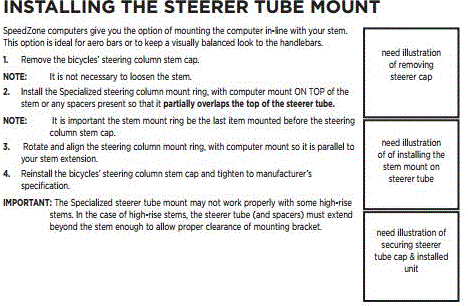
instructions for Specialized SpeedZone stem mount
So I tried a different tack: A Specialized SpeedZone Sport Wireless that I bought at my LBS. Problems abounded when I opened it: for one, the battery in the computer was dead (it takes years for a CR2032 to go dead without a load). For another, there were no instructions for using the stem mount doodad they'd included -- heck, they didn't even list it in the parts. There was a note on the instruction book, though, telling me to go to www.specialized.com and click on the "support" tab. Surprise, surprise: there is no "support" tab -- there hasn't been one in about five years! So I sent an email to what they call Rider Care asking what size stem the doodad fits... in answer to my question "are there instructions anywhere?" got this back:
specialized speedzone sport wireless
"I have included the link to the stem mount for the SpeedZone computers. This is mounted under the top cap. It is a pretty easy installation, you simply need to remove the bolt and top cap, put this mount on top of any spacers you have, and reinstall the top cap and bolt."
Of course, it took 50 hours or so to get even that response... by which time I'd already returned the damned thing (kudos to Matthews Bicycles -- returned, no questions asked). Interestingly enough, in the interim I found a PDF of the instructions, which you can see to the left. Note the "helpful" pictures... NOT.  That's not to mention that I don't have the specs for torque on the stem cap bolt and don't have a torque wrench, either.

Finally, I gave up and went back to REI and replaced the Strada with another one. So far, it seems to work just fine -- and CatEye appears to have gotten the message about their crappy instructions, at least to some point. By the by, jeers to the local Performance store: I was in there Friday, Saturday, Sunday, and Tuesday -- and the rack of computers was more or less empty every day. They really ought to be ashamed...

But will someone tell me why it is so hard to find a non-GPS enabled bicycle computer? Frankly, I don't need a GPS to tell me where I am, and I'm pretty sure that the vast majority of cyclists don't need a $300 device to tell them how fast they're going. At the other end of the spectrum, I don't know about you but I'm not gonna buy a nineteen-dollar "wireless" bike computer from some weird Chinese company...
copyright © 2017 scmrak

Thursday, May 11, 2017

The Amateur Bike Mechanic's Workbench

Park Tool PCS-10


Park Tool PCS-10 Work stand with carbon-frame bicycle held by seat post
Bicycles aren't really particularly finicky machines. Well-constructed rides can survive benign neglect for quite a while before “demanding” a tune-up, especially if they're rarely used. You’re wise to keep up your lubrication, but you might not notice problems if you don’t ride much. If you ride more than a few times a summer, though, you’re aware that regular maintenance and cleaning are absolute musts. You need a stand for those chores; one like the Park Tools PCS-10 Home Repair Stand.

The PCS-10 is considered a portable stand because it folds for storage and transport. It suspends mountain, hybrid, cyclocross, gravel, tri, or road bikes (cruisers and recumbents, too) from a top-mounted clamp that grasps tubes ranging from 7/8 to 3 inches in diameter. Lift height ranges from 39 to 57 inches, high enough to position most bikes for easy access to any component. A cam-operated, padded clamp locks the bike in place while the three-point leg system keeps everything stable. Loosen a pair of quick-release clamps, fold the legs, and the PCS-10 collapses to a compact 41” tall, small enough to lean in a corner. The quick-releases are the stand’s chief difference with the less-expensive PCS-9.

     The clamp is the heart of the PCS-10. Padded jaws, three inches wide, grasp any tubing gently – seat, top, down, head; or the seat post for a carbon frame. It closes with a slick cam arrangement to avoid over-tightening; and the whole mechanism rotates through a full 360° to lock the bike at any angle.

The PCS-10 comes disassembled in a large, 25-pound box with the tools needed for assembly. The included instructions are, sadly, a little tough to follow. They are, however, printed in four languages… Assembly takes fifteen to twenty minutes, much of which is spent flipping the paper back and forth between text and illustrations.

When assembled, the PCS-10 is an engineering marvel. It’s sturdy – its three-point stance makes it nearly impossible to tip over – and versatile. You can mount the bike in any position, rotate it while clamped in place, and raise and lower the stand easily. The footprint is large when opened (for stability), but once folded the stand is about the size of a smallish golf bag.     

Park accessories for the PCS-10 include a couple of work trays for tools (got one), a paper-towel holder (got it), a wheel truing attachment (need one), and a nylon carry bag. Fun fact: Park has trademarked this color of BLUE (their caps).
copyright © 2017 scmrak